
Private GP Clinics: 5 SEO Levers That Drive Same-Week Bookings
Turn 'near me, today' search demand into booked appointments across the UK, Australia, Canada and the US, with five levers working together.
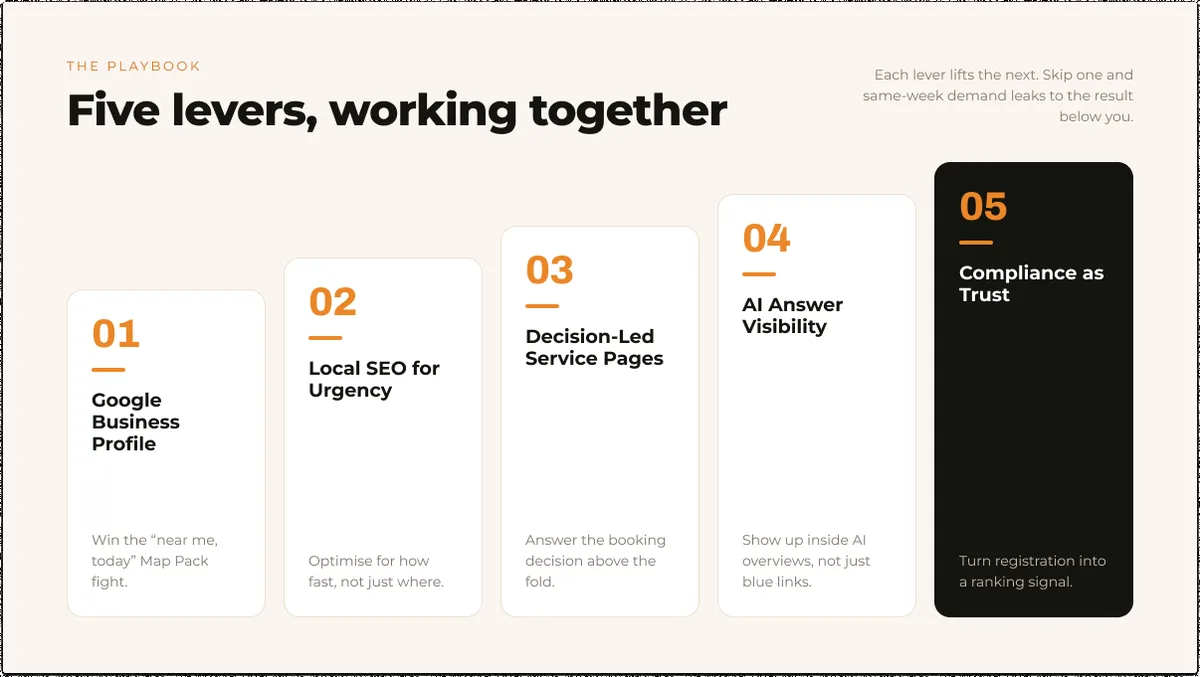
Private GP clinics need five things working together to turn search demand into same-week bookings: a Google Business Profile built for 'near me, today' searches, local SEO that signals same-day availability rather than just location, service pages structured around the decision a patient is actually making, visibility inside AI-generated answers, and compliance treated as a trust signal instead of paperwork.
This isn't a UK problem with a UK fix. The same access gap is pushing patients toward private-pay primary care in Australia, Canada and the US too, just under different names and different regulators. Get these five levers right and your private GP clinic can capture demand from people who need help this week, not patients who are still six months into research.
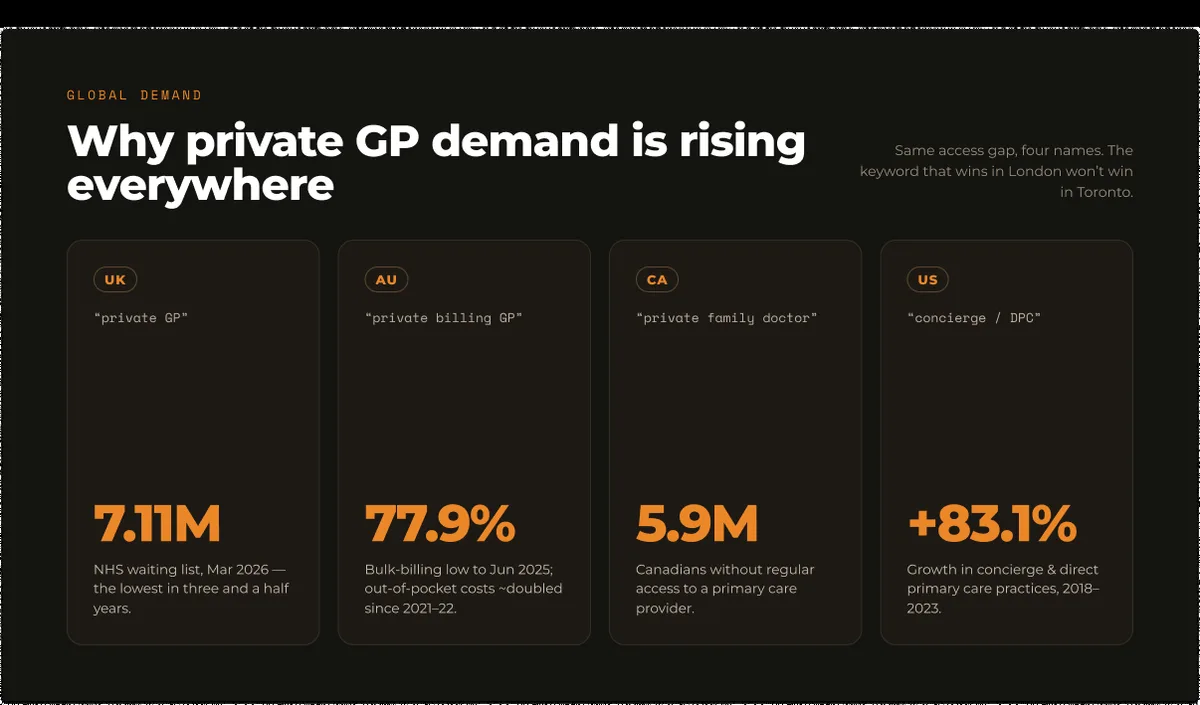
Why private GP demand is rising in every English-speaking market
The driver changes by country, but the pattern doesn't: public and insurance-based systems can't deliver fast primary care, so patients pay to skip the queue.
| Market | What patients search | What's driving demand |
|---|---|---|
| UK | "private GP" | NHS waiting lists remain elevated. NHS England's figures show the list falling to 7.11 million in March 2026, the lowest in three and a half years and down from a record 7.7 million in September 2023, though it ticked back up to 7.22 million the following month. |
| Australia | "private GP," "private billing GP" | The non-referred bulk-billing rate fell from 88.9% in 2020-21 to a low of 77.9% for the year to June 2025. A government incentive expansion has since pushed it to around 81-82% by early 2026, though out-of-pocket costs for GP visits have still roughly doubled since 2021-22. Gap fees remain a live driver of private billing. |
| Canada | "private clinic," "private family doctor," "walk-in clinic" | An estimated 5.9 million Canadians now lack regular access to a primary care provider, and 50% of Canadians report difficulty accessing a family doctor, up from 40% in 2015. |
| USA | "concierge doctor," "direct primary care," "private physician" | Concierge and direct primary care practices grew 83.1% between 2018 and 2023, against a primary care physician shortfall the AAMC projects at between 20,200 and 40,400 by 2036. |
The practical takeaway: if your clinic operates in more than one of these markets, don't assume the keyword that works in London works in Toronto or Sydney. 'Private GP' travels well in the UK and Australia. In Canada, patients search for a 'private clinic' or 'private family doctor'. In the US, 'private GP' barely exists as a search term, and that market searches for concierge medicine or direct primary care instead.
Lever 1: Win the 'Near Me, Today' Google Business Profile fight
A patient searching 'private GP near me' with same-day intent rarely scrolls past the Map Pack. Your Google Business Profile carries more weight here than it would for a slower-research specialty like cosmetic surgery, because the searcher wants an answer in the next few minutes, not the next few weeks.
Get the basics exactly right:
- Category accuracy: use the most specific category available (general practitioner or private medical clinic, not a generic 'doctor' catch-all).
- Live opening hours: a profile showing 'closed' when you're actually open kills same-day conversions instantly.
- A working booking link, not just a phone number, since a growing share of same-day searches happen outside your reception hours.
- Pre-seeded Q&A answering the questions patients actually ask: 'Can I book today without insurance?' 'Do you accept walk-ins?'
If you operate in Australia, this section needs an extra layer of care. Organic reviews appearing natively on your Google Business Profile are generally outside your direct control, and AHPRA has confirmed that practices can ask patients to leave Google reviews. The real risk sits elsewhere: featuring, pinning or screenshotting a review that mentions a specific clinical outcome anywhere you do control, including your own website, social posts or marketing materials, is what crosses into prohibited testimonial territory under the National Law.
Lever 2: Build local SEO around urgency, not just location
Standard local SEO optimises for 'where'. Private GP clinics also need to optimise for 'how fast'.
For multi-location clinics, that means:
- A dedicated page per location, each with its own same-day availability messaging rather than one generic 'our locations' page.
- Consistent name, address and phone details (NAP) across every directory and citation, because inconsistency is one of the more common reasons map pack rankings stall.
- Location pages that mention nearby landmarks or transport links naturally, since 'near me, today' searches skew heavily toward people who need to walk in within the hour.
This is the one lever where the UK, Australia and Canada overlap almost exactly in approach, since all three have dense urban clinic markets where same-day proximity genuinely decides which clinic gets the booking.
Lever 3: Structure service pages around the decision patients are making
A patient comparing private GP options isn't weighing your clinical credentials against a competitor's the way a plastic surgery patient might over months. They're deciding, often within minutes, whether to call you or the next result down.
That decision usually comes down to three things your service pages should answer immediately, above the fold:
- Can I be seen today or this week?
- What will it actually cost, and do I need insurance?
- How do I book right now?
Pricing transparency matters more here than in most healthcare niches. As one example of how a competitor handles this, London Doctors Clinic publishes a clear from-price for private GP appointments rather than hiding cost behind a contact form. You don't need to match their exact figure, but the principle of stating a clear starting price (or a clear 'prices from' range) consistently outperforms forcing patients to enquire just to find out what something costs.
Your website structure should support this too: booking CTA visible without scrolling, opening hours and same-day availability stated clearly, and no-insurance-needed messaging where that's genuinely true.
Lever 4: Earn visibility inside AI-generated answers, not just Google's blue links
Search results for health queries increasingly show an AI-generated summary before a single traditional listing. A patient typing 'private GP near me with same-day appointments' into Google, or asking ChatGPT or Gemini the same question, is a realistic scenario now, not a future one.
AI search optimisation for this niche rests on a few concrete things:
- Clear, structured FAQ content that directly answers the questions patients ask, written so an AI system can lift a self-contained answer without losing meaning.
- Consistent details about your clinic (services, hours, locations, registration status) across your site and every third-party directory, since AI systems cross-reference these for confidence.
- Being mentioned in genuine third-party comparison and 'best private GP in [city]' content, not just your own site, because AI answer engines weight independent corroboration heavily.
Lever 5: Make compliance a ranking asset, not just a legal checkbox
This is the lever competitors skip, and it's also the one most likely to differ by market.
United Kingdom. Most private GP clinics need full registration with the CQC, and that status should be visible on your site, not buried. Under the CAP Code's healthcare rules, referencing certain medical conditions in advertising can trigger a requirement that any advice or treatment is delivered under suitably qualified supervision. Keep claims about what you treat factual and avoid implying diagnosis or cure where you can't substantiate it.
Australia. On top of the testimonial risk covered in Lever 1, AHPRA's rules specifically flag advertising that creates a false sense of urgency, such as language like 'don't delay' or 'time is running out', where there's no clinical reason for it. The distinction that matters is between stating a genuine fact ('same-day appointments available') and manufacturing pressure where none clinically exists.
Canada. Advertising for private clinics is regulated provincially, through bodies like the College of Physicians and Surgeons in each province, and the specifics vary. The common thread is the same as everywhere else: claims must be accurate, and comparative or guarantee-style claims are generally not allowed.
United States. Expect a lighter federal touch through the FTC's general truth-in-advertising rules, layered with state-specific medical board requirements that vary by where the clinic is licensed.
Registration numbers, professional credentials and genuine, outcome-free reviews are exactly the kind of trust signals that support E-E-A-T. Done properly, compliance and ranking pull in the same direction.
Next steps
- Audit your Google Business Profile category, hours and booking link this week.
- Build or update a dedicated local landing page for each clinic location, with same-day availability stated clearly.
- Add a clear 'prices from' figure and no-insurance-needed messaging to your top service pages, if accurate.
- Check how your top three services currently appear (or don't) in ChatGPT, Gemini and Perplexity.
- Confirm your CQC, AHPRA, provincial College or state board registration is visibly linked from your homepage and footer.
- Review pinned or screenshotted Google reviews for clinical-outcome language, especially if you operate in Australia.
- Book a free visibility check to see exactly where your clinic currently stands across Google, Maps and AI search.
Frequently asked questions
How much does a private GP appointment typically cost?
Pricing varies by clinic and market. As a published reference point, London Doctors Clinic lists UK private GP appointments from £89. Always check directly with a specific clinic, since fees depend on appointment length, location and what's included.
Do private GP clinics need to register with a regulator before advertising?
In most cases, yes. The UK requires CQC registration for most private GP services, Australia requires compliance with AHPRA's National Law advertising rules, Canada regulates through provincial Colleges of Physicians and Surgeons, and the US applies state medical board rules alongside FTC advertising standards.
Can private GP clinics legally advertise same-day appointments?
Yes, stating genuine availability is factual advertising. The risk comes from implying urgency that doesn't exist clinically, which AHPRA in Australia specifically calls out, or from making guarantees about being seen that you can't reliably deliver.
How long does local SEO take to show results for a private GP clinic?
Realistically, three to six months for compounding results, though Google Business Profile improvements can shift map pack visibility faster than core organic rankings.
Does AI search actually affect how private GP clinics get found?
Increasingly, yes. AI-generated overviews and chatbot answers are appearing for health-related searches more often, alongside traditional Google results, which is why structured, consistent information across your site and directories matters.
What's the difference between SEO and paid ads for a private GP clinic?
SEO builds compounding visibility over months and tends to cost less per enquiry over time. Paid ads can fill gaps immediately, which matters for a niche where same-week demand is the whole point.
Is rising demand for private GP services a UK trend, or is this happening everywhere?
It's global. The UK, Australia, Canada and the US are all seeing patients turn to paid primary care alternatives, driven by NHS waiting lists, rising out-of-pocket GP costs, family doctor shortages and primary care physician shortfalls respectively. The names differ (private GP, concierge medicine, direct primary care) but the underlying access gap is the same.
Want results like these for your clinic?
Book a free audit and we'll show you exactly where the opportunities are.
