
Local SEO for Dentists: The Complete Checklist to Rank in the Map Pack
The Map Pack captures 68% of clicks on dentist near me searches. Here is the full checklist mapped to Google's three ranking pillars, in the order that moves fastest.
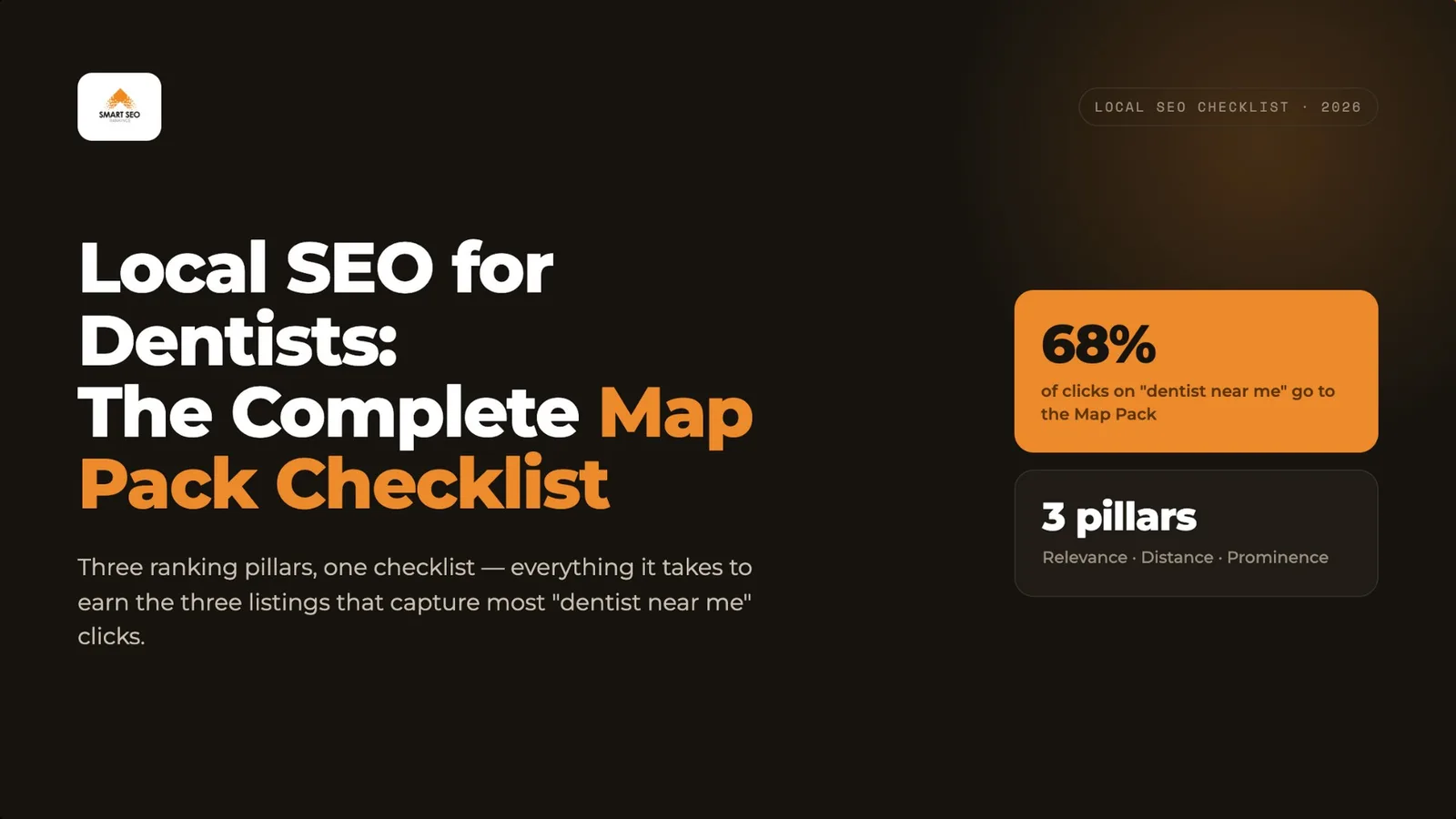
The Google Map Pack, the three listings with the map that appear at the top of every dentist near me search, captures 68% of all clicks on local dental queries. Not your website, not your ads, and not your social profiles. The Map Pack is where most new patients decide which practice to call.
Google determines which three practices appear using three official ranking pillars: Relevance, Distance and Prominence. This checklist maps every practical action to each pillar, in the order that produces results fastest, including what has changed in 2026 with AI search now pulling directly from the same Google Business Profile that feeds the Map Pack.
Why the Map Pack matters more in 2026 than it did in 2024
AI Overviews haven't replaced the Map Pack, they've made it more valuable. When Google's AI Overview appears on a results page, it compresses clicks to the traditional organic links below it. Much of that diverted traffic shifts toward the Map Pack, which Google has largely kept intact above AI Overviews for near me style queries.
AI answer engines now pull directly from your Google Business Profile. ChatGPT, Perplexity and Gemini increasingly use profile data when answering prompts like who is a good dentist near me. The same optimisations that win the Map Pack now feed AI search visibility simultaneously. With 76% of people who perform a near-me search visiting a business within 24 hours, the Map Pack converts at a rate no other dental marketing channel matches.
How Google decides who gets into the Map Pack
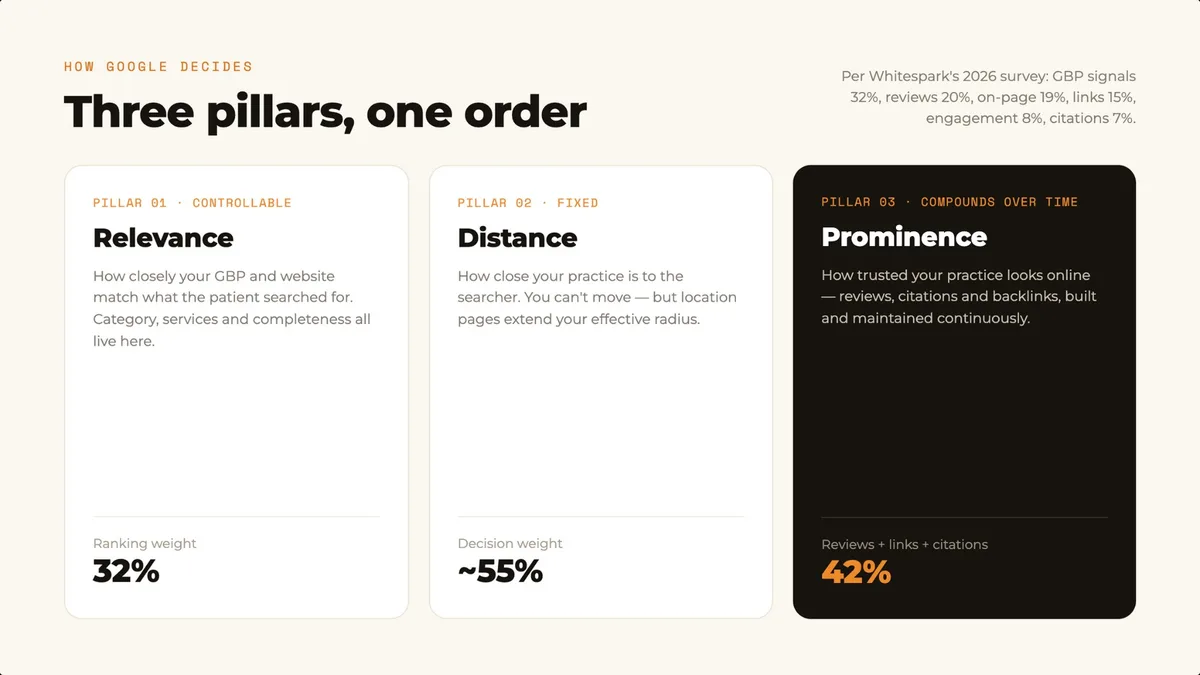
| Pillar | What it measures | Can you control it? |
|---|---|---|
| Relevance | How closely your profile and website match what the patient searched for | Yes, the most controllable pillar |
| Distance | How close your practice is to the searcher's location | Partially, you can't move, but you can expand your effective radius |
| Prominence | How trusted and established your practice looks online | Yes, built over time through reviews, citations and backlinks |
According to Whitespark's 2026 Local Search Ranking Factors survey of 47 expert practitioners, ranking weight breaks down as: profile signals 32%, review signals 20%, on-page SEO 19%, link signals 15%, behavioural engagement signals 8% and citation signals 7%. Proximity sits above all of these at roughly 55% of decisions but is largely outside direct control.
Pillar 1: relevance, your Google Business Profile checklist
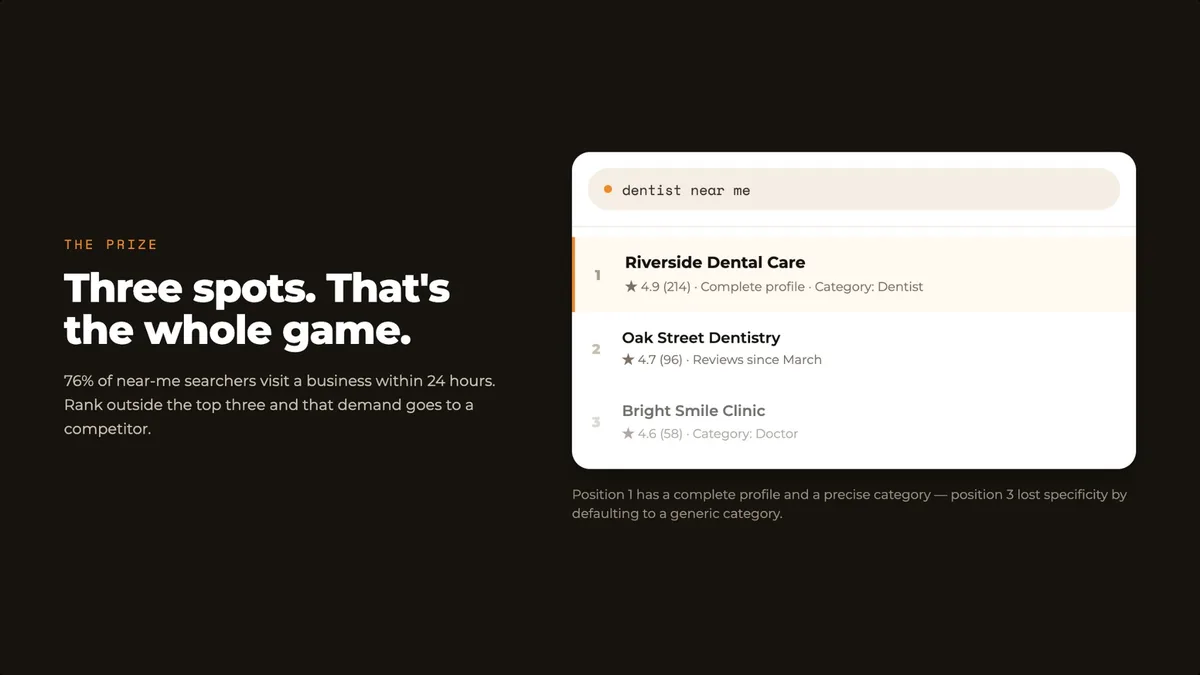
Your Google Business Profile is the single biggest lever in your Map Pack ranking. Profile signals carry 32% of Local Pack ranking weight, more than any other signal category, and almost all of them are directly controllable.
- Claim and verify your listing if you haven't already. Unverified profiles don't rank.
- Set your primary category with precision. Dentist is correct for a general practice, but cosmetic dentist, emergency dental service or dental implants periodontist are the right primary categories if those are your main treatment lines.
- Add secondary categories for every treatment type you offer.
- Complete every field in your profile. Practices with a complete profile are 70% more likely to be clicked, according to Google's own data.
- List every service using the specific treatment names patients actually search: dental implants, Invisalign, emergency dental, teeth whitening.
- Write a business description that includes your key services and location naturally, without keyword stuffing.
- Set your hours accurately, including any extended or weekend hours.
- Add a booking link that routes directly to appointment booking, not a generic homepage.
- Upload fresh photos regularly. Aim for at least two to four new photos per month.
- Post to your profile at least once a month.
- Seed your Q&A section with the questions patients actually ask, then answer them yourself.
- Enable messaging if available in your market.
For multi-location practices, consider whether a practitioner listing is appropriate alongside your practice listing. In a multi-dentist practice this allows the practice to rank for dentist near me while an individual practitioner listing ranks for Invisalign provider or cosmetic dentist. For a solo practitioner, manage one powerful profile rather than diluting your reviews across two weak ones.
Pillar 2: distance, expanding your effective radius
- Build dedicated location pages for every suburb, postcode area or neighbourhood you genuinely serve, with real location-specific content rather than thin doorway pages.
- Reference local landmarks and transport links naturally in location page content.
- Set your service area accurately in your profile if you operate across multiple sites.
- Ensure the embedded Google Map on your contact page links to your verified listing, not a pinned map without a business connection.
Your website structure is what makes location-page strategy work. Thin pages on slow sites don't rank regardless of how well they're written.
Pillar 3: prominence, reviews and citations checklist
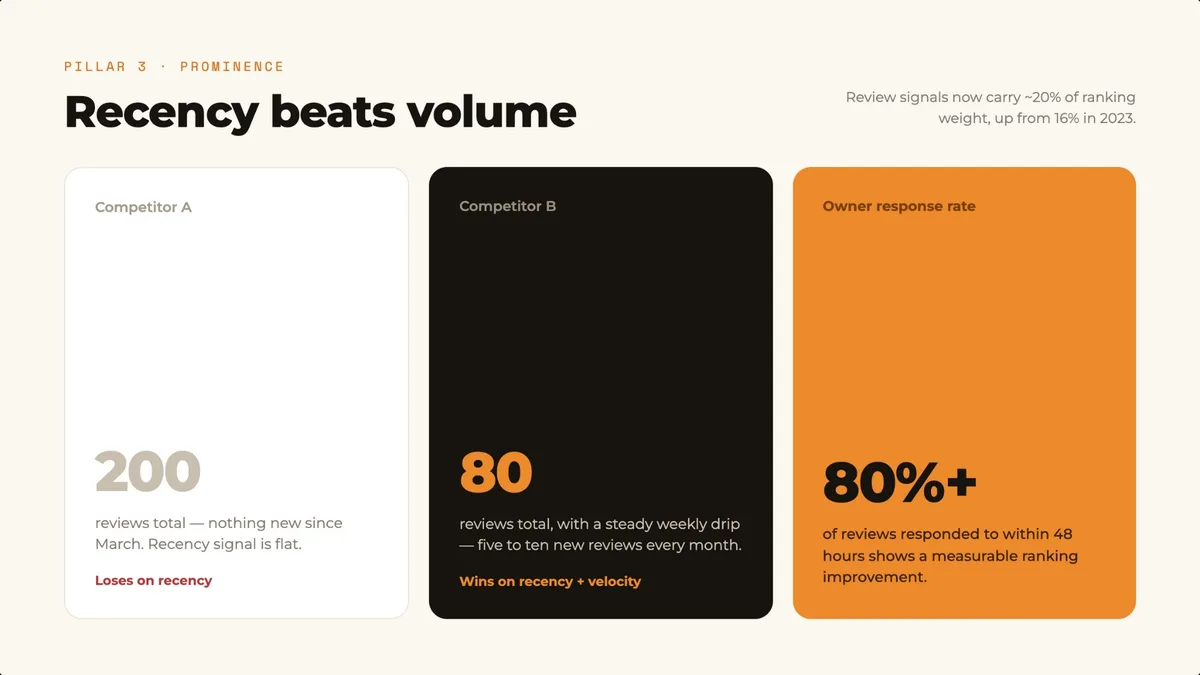
Review signals now carry approximately 20% of Local Pack ranking weight, up from 16% in 2023. Google evaluates review velocity, recency, sentiment and specificity, and owner response rate. Businesses responding to 80% or more of reviews see measurable ranking improvement.
- Build review requests into your daily checkout process, not as a periodic campaign. SMS-based requests generate measurably higher completion rates.
- Aim for five to ten new Google reviews per month for a typical single-location practice.
- Respond to every review within 48 hours, never including patient names or clinical details.
- Encourage specificity. Reviews that mention specific procedures help you rank for those service-specific queries.
- Don't use Yelp in automated review request flows. Yelp actively filters reviews that appear solicited.
- Don't offer incentives for positive reviews. This violates FTC guidelines in the US, ASA rules in the UK and equivalent frameworks in Australia and Canada.
Compliance note by market
- UK: the GDC's advertising guidance prohibits creating an unjustified expectation of results. Don't respond to reviews by confirming or expanding on clinical outcomes mentioned.
- Australia: AHPRA prohibits testimonials referencing clinical outcomes in any content your practice controls.
- Canada and US: soliciting honest reviews is permitted, with no incentivising of false or exclusively positive reviews.
Citations and NAP consistency
Citation signals carry 7% of Local Pack ranking weight directly, a smaller share than reviews or profile signals, but NAP inconsistency actively suppresses rankings by creating conflicting signals about your practice's location and legitimacy.
- Create one master NAP document with your exact practice name, address and phone number, and match it everywhere.
- Audit your existing citations before building new ones. Duplicate listings and inconsistent data are more damaging than missing citations.
- UK priority directories: Google Business Profile, NHS website, Dental Directory, Yell, Bing Places, Apple Business Connect, CQC register where applicable.
- Australia: Google Business Profile, HealthEngine, HotDoc, Healthdirect Service Finder, Bing Places, Apple Business Connect, Australian Dental Association directory.
- Canada: Google Business Profile, Bing Places, Apple Business Connect, RateMDs, provincial dental association directories, Yellow Pages Canada.
- US: Google Business Profile, Bing Places, Apple Business Connect, Healthgrades, Zocdoc, Yelp organic only, WebMD, Vitals, local chamber of commerce.
- Update your NAP across all directories immediately whenever anything changes.
Local backlinks
- Get listed on your local dental association's website.
- Pursue a link from your local chamber of commerce or business association.
- Partner with complementary local health businesses for cross-referral mentions and links where appropriate.
- Sponsor a local school dental health event or community initiative.
On-page signals: your website's role in Map Pack rankings
Your website supports your profile, it doesn't replace it. On-page signals carry 19% of Local Pack ranking weight and are fully in your control.
- Use LocalBusiness and Dentist schema on your homepage and service pages.
- Include your NAP in your website footer on every page, matching your profile exactly.
- Embed your Google Map on your contact page, linked to your verified listing.
- Create a dedicated page for each major treatment with location-specific content.
- Optimise page titles and H1s to include the treatment and location naturally.
- Keep mobile page speed under 2.5 seconds on a cellular connection.
- Put click-to-call on every page, visible without scrolling on mobile.
Healthcare SEO at a website level is what turns Map Pack rankings into actual booked appointments. The Map Pack gets the click, your website and booking flow closes it.
AI search: why your Map Pack checklist is also your AI visibility checklist
ChatGPT, Perplexity and Gemini increasingly pull from profile data when answering best dentist near me style prompts. Two additional steps specifically for AI search: structure your FAQ content to directly answer the exact questions patients ask AI tools, and pursue genuine third-party mentions in local dental comparison content and healthcare directory features.
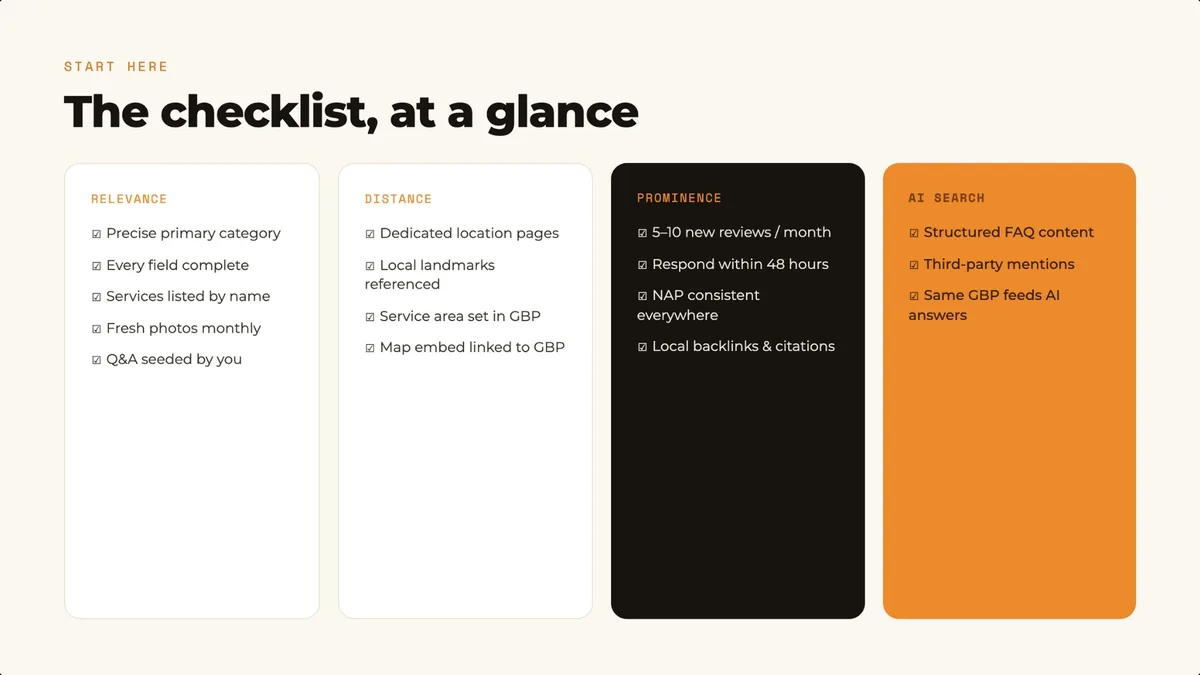
Next steps
- Set your primary category to the most specific match for your practice's main treatment focus.
- Complete every section of your profile this week, especially services, Q&A and photos.
- Run a NAP audit against your master document across your top 10 directory listings.
- Build review requests into your daily checkout or appointment follow-up process.
- Check whether dedicated location pages exist for every suburb or area you actively serve.
- Confirm Dentist and LocalBusiness schema is implemented on your homepage.
- Type your practice name into ChatGPT and Perplexity and note what, if anything, they say.
Frequently asked questions
How long does it take to rank in the Google Map Pack for a dental practice?
Profile improvements, especially category and completeness fixes, can shift Map Pack visibility within one to two weeks. Top-three positions for competitive dentist near me terms in urban markets typically require three to six months of consistent work across all three pillars.
What's the single most important thing a dentist can do to rank in the Map Pack?
Set the right primary category. Per Whitespark's 2026 Local Search Ranking Factors survey, it's the single highest-impact individual action in the entire local ranking algorithm.
How many Google reviews does a dental practice need to rank in the Map Pack?
Total count matters less than velocity and recency. A practice with 80 reviews and five new ones this month consistently outranks a competitor with 200 reviews and nothing recent.
Do citations still matter for dental local SEO in 2026?
Yes, but as a hygiene factor rather than a growth lever. Getting your NAP consistent across the top 40 to 60 relevant directories removes a ranking suppressor, but won't move you from position four to position one on its own.
Does the Map Pack or organic search matter more for dentists?
The Map Pack for most practices. Organic search matters specifically for high-research treatments like implants, where patients spend weeks comparing before deciding.
Is local SEO for dentists different in the UK, Australia and Canada compared to the US?
The ranking mechanics are identical. What differs is the directory landscape, the review compliance rules and the terminology patients use in searches.
Want results like these for your clinic?
Book a free audit and we'll show you exactly where the opportunities are.