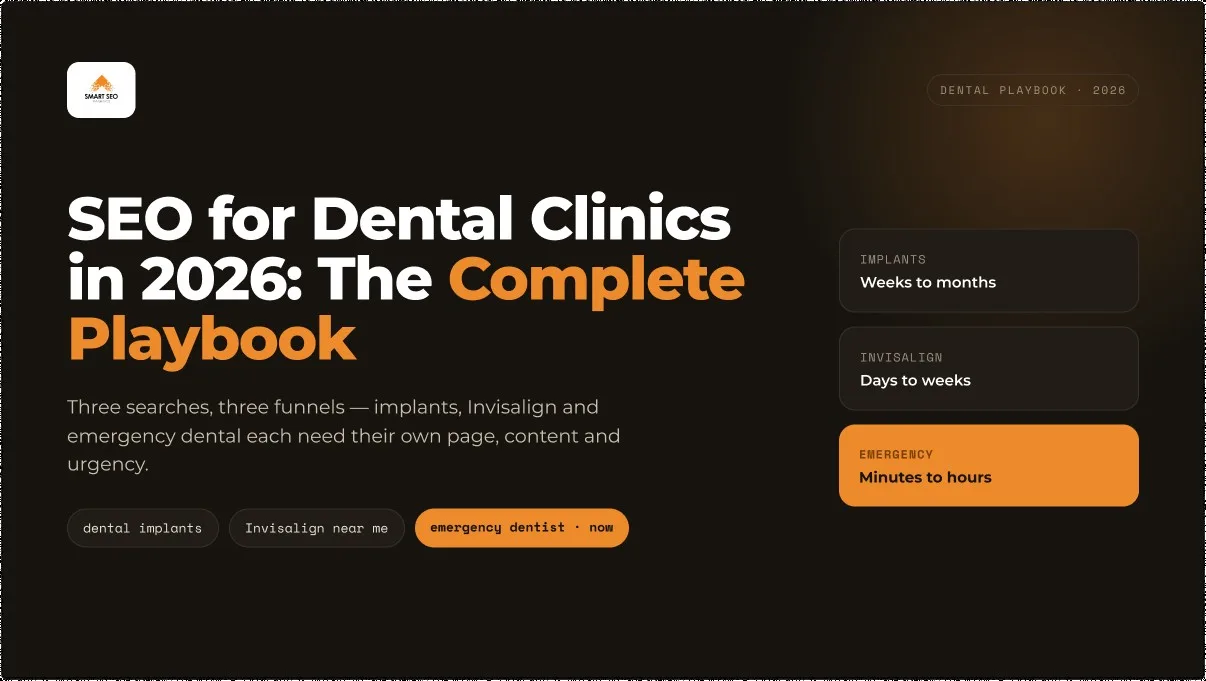
SEO for Dental Clinics in 2026: The Complete Playbook
Implants, Invisalign and emergency dental are three different funnels, not one dental SEO strategy. Here is how to build a page, a message and a level of urgency for each.
Dental clinics don't lose patients to bad SEO in general. They lose them in three specific moments: when someone researching implants picks a different practice after weeks of comparison, when an Invisalign shopper goes straight to a direct-to-consumer brand because your site never came up, and when someone in pain at 9pm finds a competitor's 'open now' listing instead of yours.
Each of those three searches needs a different page, different content, and a different level of urgency in how your site is built. This playbook treats them as three separate acquisition funnels, not one generic dental SEO strategy, and builds in what has changed for 2026: a major NHS dental contract reform in the UK, continued double-digit growth in implant and aligner demand, and AI search now sitting above traditional results for most of these queries.
Why implants, Invisalign and emergency searches deserve separate strategies
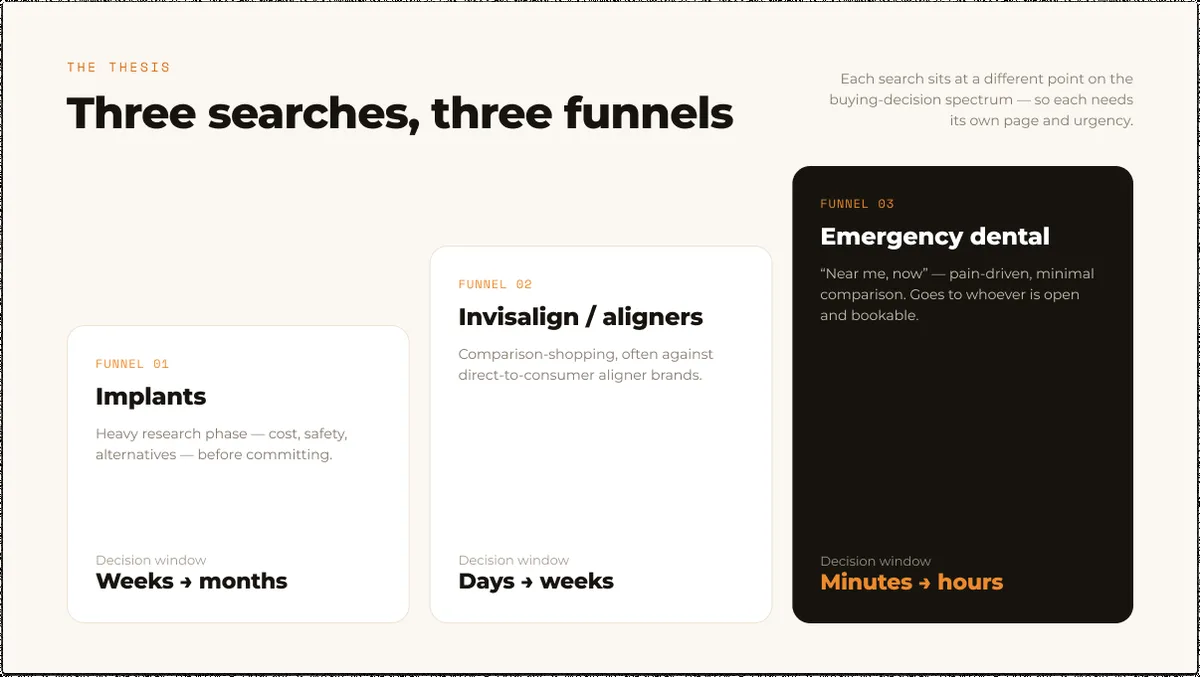
These three treatment lines sit at completely different points on the buying-decision spectrum for dental clinics, and that difference should drive how you build content and pages for each.
| Treatment | Search behaviour | Typical decision window |
|---|---|---|
| Implants | Heavy research phase: cost, safety, alternatives, before committing | Weeks to months |
| Invisalign / clear aligners | Comparison-shopping, often against direct-to-consumer aligner brands | Days to weeks |
| Emergency dental | "Near me, now", pain-driven, minimal comparison | Minutes to hours |
Demand for the first two is genuinely rising. Independent market analysts disagree sharply on exact figures for both the implant and clear aligner markets, but every analyst tracking the space agrees on the direction: consistent double-digit growth, driven by an ageing population needing tooth replacement and a structural shift toward adult orthodontics. On the clear aligner side, Align Technology's own disclosed figures show it had treated over 17 million Invisalign patients by 2023, up from 10.9 million in 2020, including 4.5 million teens.
Emergency dental works differently. This isn't a growing market in the same sense, it's a constant, urgent slice of demand that goes to whichever practice is easiest to find and book at the moment.
Implants: winning the multi-week research phase
A patient researching implants is reading reviews, comparing prices, and asking the same handful of questions across every practice site they visit. Your content needs to answer those questions better than the practice three results below you.
- A dedicated implants page, not a paragraph buried in a general services page, covering cost ranges, the procedure itself, recovery timeline, and who isn't a good candidate.
- Genuine FAQ content addressing the questions that actually drive hesitation: pain during the procedure, how long implants last, what happens if a patient isn't a candidate for a same-day implant.
- Local SEO built around 'dental implants [city]' and 'dental implants near me', since even a considered purchase eventually narrows down to which of my local options.
- Financing and payment plan information clearly stated, since cost is consistently the biggest objection for implant treatment and burying it behind a contact us for pricing form costs you patients who will simply go elsewhere to find a number.
This is also where your website structure matters most. A patient who has spent three weeks researching implants elsewhere shouldn't land on your site and still be unable to find a straight answer on cost or financing.
Invisalign and clear aligners: competing with direct-to-consumer brands
Invisalign search behaviour looks different from implants because the comparison set is different. You're not just competing with the dentist down the road, you're competing with direct-to-consumer aligner brands offering a lower-cost, no-in-person-visit alternative.
- Content that's honest about what direct-to-consumer aligners can't do: supervision by a dentist throughout treatment, in-person adjustment of treatment if something isn't tracking correctly, rather than vague claims about being better.
- A genuine before-and-after gallery where your specific regulator allows it.
- Clear visibility into the actual process: scan, treatment plan, number of aligners, check-in cadence, so patients researching online can compare your offer like-for-like against a direct-to-consumer brand's marketing.
- Local SEO targeting 'Invisalign near me' and 'clear aligners [city]', since even patients who started researching direct-to-consumer brands often end up wanting an in-person provider once they understand what's involved.
Emergency dental: winning the near me, now search
Emergency dental search behaviour mirrors what drives same-day demand in private GP and urgent care more broadly: the patient isn't comparing qualifications, they're finding whoever is open and reachable right now. The UK context here has genuinely changed for 2026. From 1 April 2026, every NHS dental practice with a contract of 100 or more Units of Dental Activity must deliver 8.2% of its contract value as urgent or unscheduled care, paid at £75 per urgent course of treatment, the largest reform to the NHS dental contract since 2006.
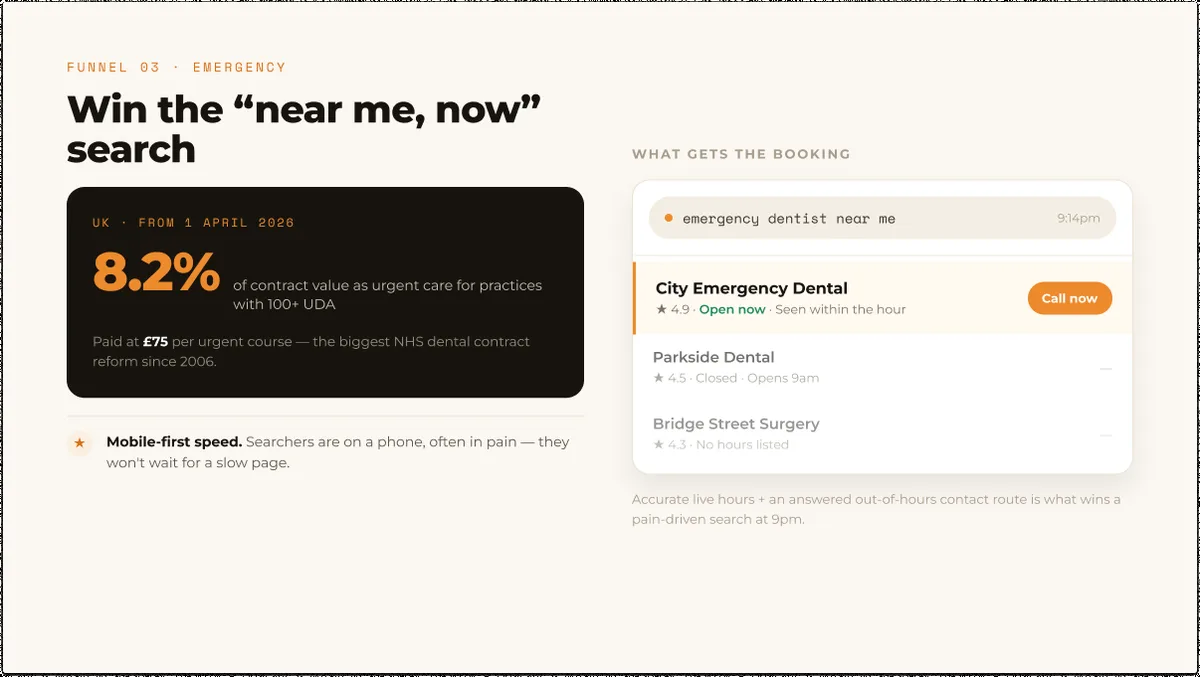
- A Google Business Profile with accurate, live opening hours and an emergency contact route that actually gets answered outside normal hours.
- A dedicated emergency dentist page stating clearly what counts as a dental emergency and how quickly you can see someone, not a generic contact page.
- Mobile-first page speed, since almost everyone searching 'emergency dentist near me' is doing it on a phone, often in pain, and won't wait for a slow page to load.
- Google and Meta Ads as a genuine complement here, not a fallback, since emergency searchers convert immediately and organic visibility for near me, now queries takes time to build even when done well.
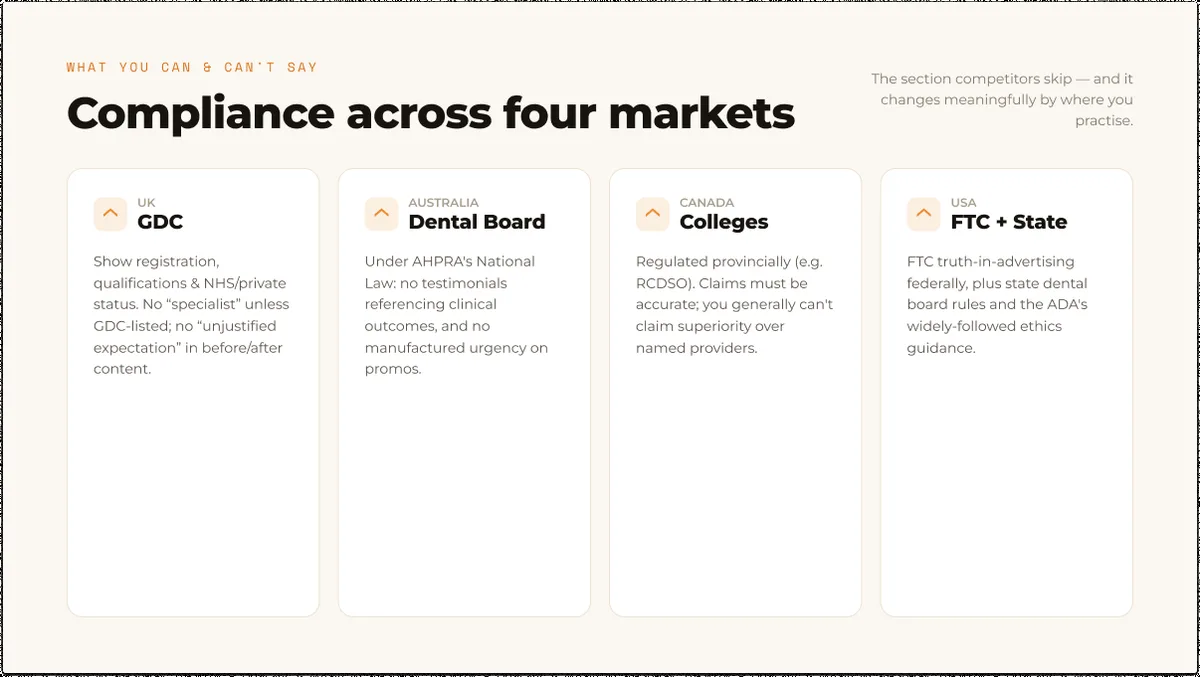
Compliance across four markets: what you can and can't say
| Market | Regulator | What it means for your marketing |
|---|---|---|
| United Kingdom | GDC | Show your registration number, qualifications and whether you are NHS, private or mixed. You can't use the title specialist unless you're on the GDC specialist list, and claims must avoid creating an unjustified expectation of results. |
| Australia | Dental Board under AHPRA | Testimonials referencing clinical outcomes are prohibited in your own controlled advertising, and language implying urgency where there is no clinical reason for it is specifically flagged. |
| Canada | Provincial Colleges | Regulated provincially, for example the Royal College of Dental Surgeons of Ontario. Claims must be accurate and you generally can't claim superiority over other named providers. |
| United States | FTC plus state boards | FTC truth-in-advertising rules at federal level, layered with state dental board requirements, alongside the American Dental Association's widely followed ethics guidance. |
Showing up in AI search, not just Google's map pack
All three of these searches increasingly surface an AI-generated answer before a traditional listing. AI search visibility for dental depends on the same fundamentals as the rest of healthcare: clear, structured content that directly answers the question asked, consistent practice details across your site and directories, and genuine third-party mentions rather than only your own marketing copy.
Next steps
- Build or update three separate, dedicated pages: implants, Invisalign or clear aligners, and emergency dental, rather than folding them into a general services page.
- Add clear financing and pricing information to your implants page if you don't already have it.
- Audit your Google Business Profile hours and emergency contact route for accuracy this week.
- Check your before-and-after content against your specific regulator's testimonial and outcome-claim rules.
- Confirm your GDC registration number, or AHPRA, provincial College or state board equivalent, is visibly displayed.
- Check how your implant, Invisalign and emergency pages currently appear in ChatGPT, Gemini and Perplexity.
Frequently asked questions
Is dental implant demand actually growing, or is that just marketing language?
Yes, directionally. Market research firms disagree on exact figures, with estimates varying by billions depending on methodology, but every major analyst agrees on consistent double-digit growth, driven mainly by an ageing population and rising acceptance of implant-based treatment over dentures.
How is Invisalign marketing different from general dental marketing?
The comparison set is different. Patients researching Invisalign are often also comparing you against direct-to-consumer aligner brands, not just other local dentists, so your content needs to clearly explain what in-person, dentist-supervised treatment offers that a mail-order aligner kit doesn't.
What changed with the NHS dental contract in 2026?
From 1 April 2026, NHS dental practices with 100 or more Units of Dental Activity must deliver at least 8.2% of their contract value as urgent or unscheduled care, the biggest reform to the NHS dental contract since 2006. This changes how urgent NHS access works and affects how private and mixed practices should position emergency availability.
Can I use before-and-after photos in dental marketing?
It depends entirely on your market. In the UK, the GDC requires that claims don't create an unjustified expectation of results. In Australia, AHPRA prohibits testimonials referencing clinical outcomes. Always check your specific regulator before using treatment outcome imagery in marketing.
Do I need different SEO strategies for implants versus emergency dental?
Yes. Implant searches involve weeks of research and respond to in-depth content, financing transparency and local SEO. Emergency searches are decided in minutes and depend on accurate Google Business Profile hours, fast mobile pages and a contact route that actually gets answered.
Does AI search affect how patients find dental practices?
Increasingly, yes. AI-generated answers are appearing above traditional search results for treatment-related queries, which is why structured, directly-answering content matters more than it did even a year or two ago.
What's the fastest win for a dental practice starting this playbook from scratch?
Usually the emergency dental page and Google Business Profile audit, since both can be fixed within days and emergency searches convert immediately, unlike implant or Invisalign content, which takes longer to build and rank.
Want results like these for your clinic?
Book a free audit and we'll show you exactly where the opportunities are.