Is Your Dental Practice Showing Up in ChatGPT, Gemini and Google AI Overviews?
ChatGPT recommends just 1.2% of local businesses. Here is what AI search actually does for dental practices in 2026, where the visibility gaps are, and the six fixes that matter in order.
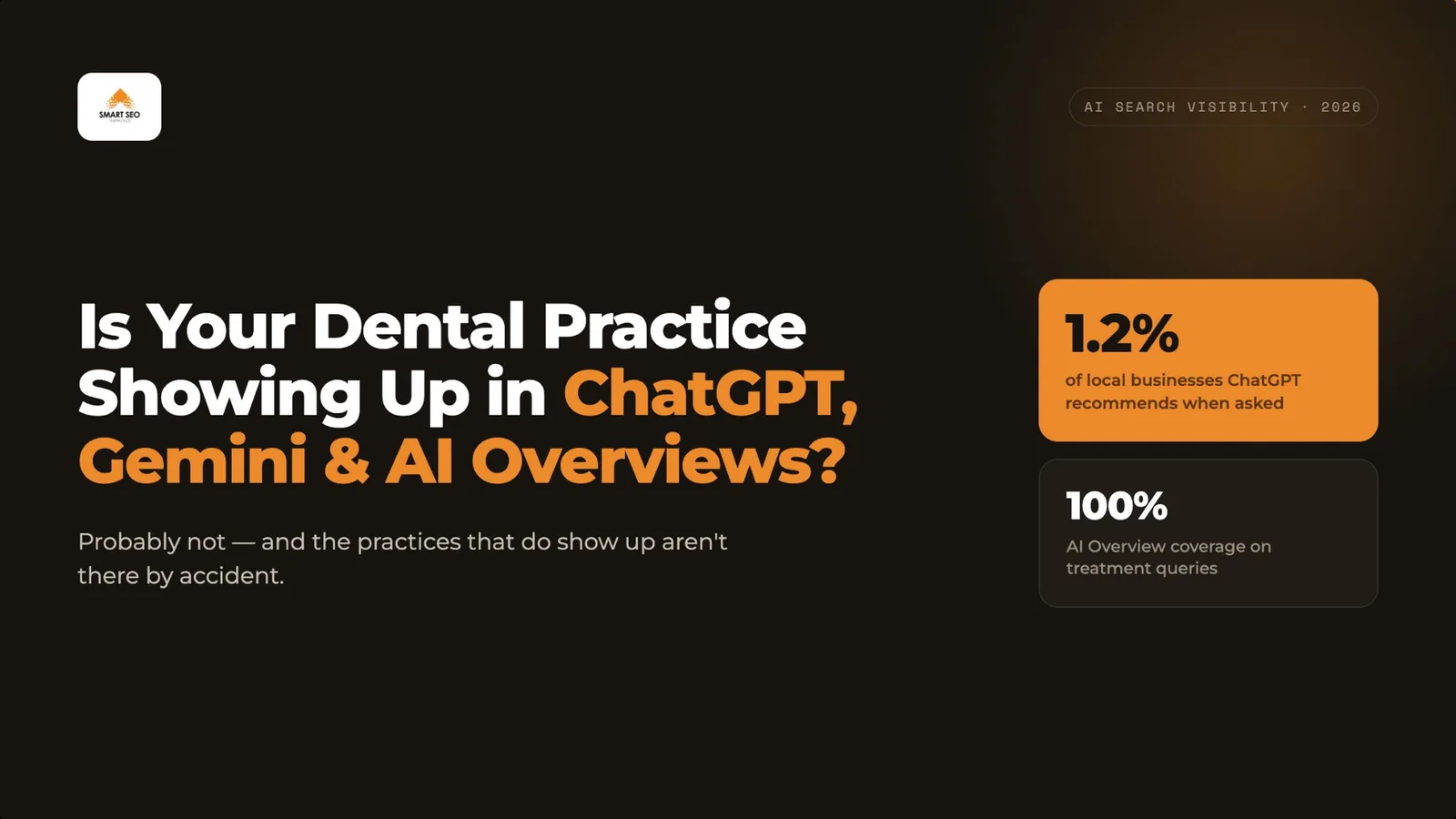
Probably not, and the practices that are showing up aren't ranking there by accident. According to a 2026 SOCi Local Visibility Index analysis of more than 350,000 business locations, ChatGPT recommends just 1.2% of local businesses when asked for provider recommendations. For dental practices, that number is even more selective, because AI platforms apply an extra layer of clinical scrutiny before citing a healthcare source.
The good news is that the practices being cited share a clear set of characteristics, and most of them are things you can fix this quarter. This article explains exactly what AI search does and doesn't do for dental clinics right now, where the real visibility gaps are, and what to prioritise first.
What AI search actually does for dental practices in 2026
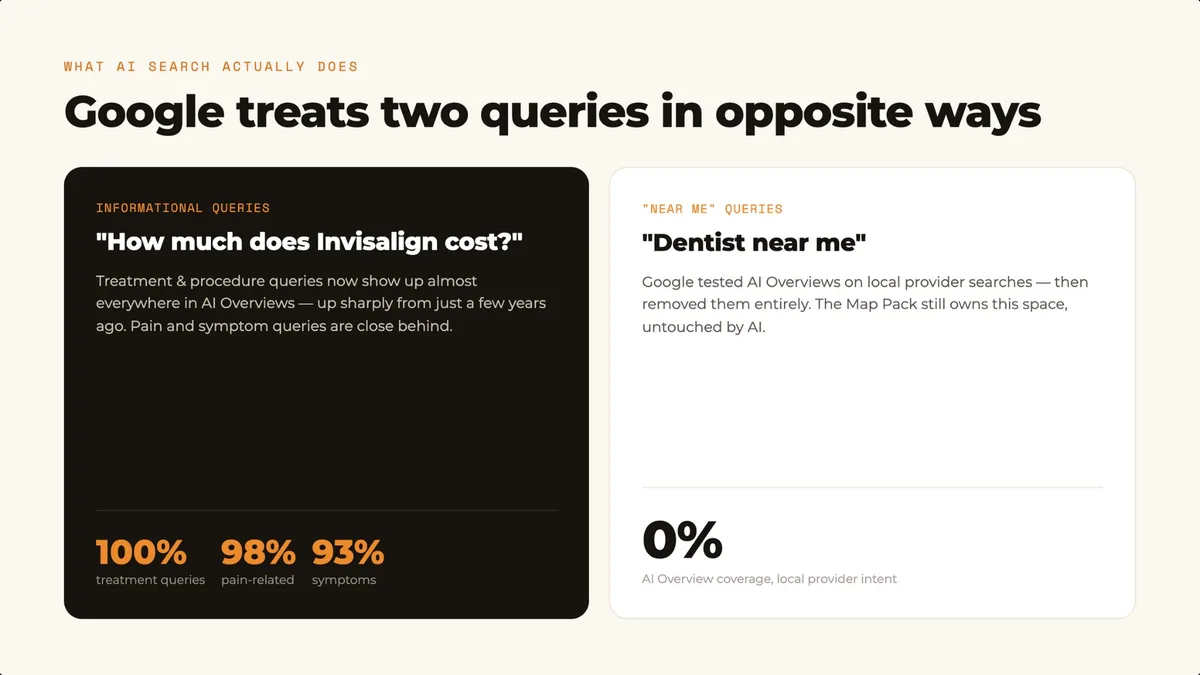
Before tackling what to fix, it's worth being precise about what AI search is doing, because one of the most common mistakes dental practices make right now is optimising for the wrong type of query. AI search for dental practices splits into two completely separate scenarios, and Google treats them in opposite ways.
Scenario 1: informational queries with high AI coverage
When a patient searches for information about a treatment, symptom or procedure, Google AI Overviews now appear on an enormous share of those searches. According to BrightEdge's three-year healthcare tracking study, treatment and procedure queries now show 100% AI Overview presence, up from 45% in 2023. Pain-related queries show 98% coverage. Symptoms and conditions hit 93%.
For dental practices, this means when a patient searches how much does Invisalign cost, how long does a dental implant take, or what causes tooth sensitivity, Google is answering those questions itself, above your website, using sources it has decided to trust. If your practice isn't one of those sources, you're invisible at the exact moment the patient is forming an opinion about their treatment options.
Scenario 2: local near me queries with zero AI coverage
According to BrightEdge's data, Google tested AI Overviews on local provider searches like dentist near me and pediatric dentist near me, and then removed them entirely. By December 2025, 0% of local provider-intent queries were triggering AI Overviews. Google has decided, at least for now, that local healthcare provider searches should be handled by the Map Pack and organic listings, not AI summaries.
What this means practically: your local SEO and Google Business Profile investments still pay off directly and are not being disrupted by AI for near me queries. But your treatment content needs to be written so that AI can cite it for the informational queries that now sit above your organic listings.
The three AI surfaces that matter for dental clinics
Google AI Overviews
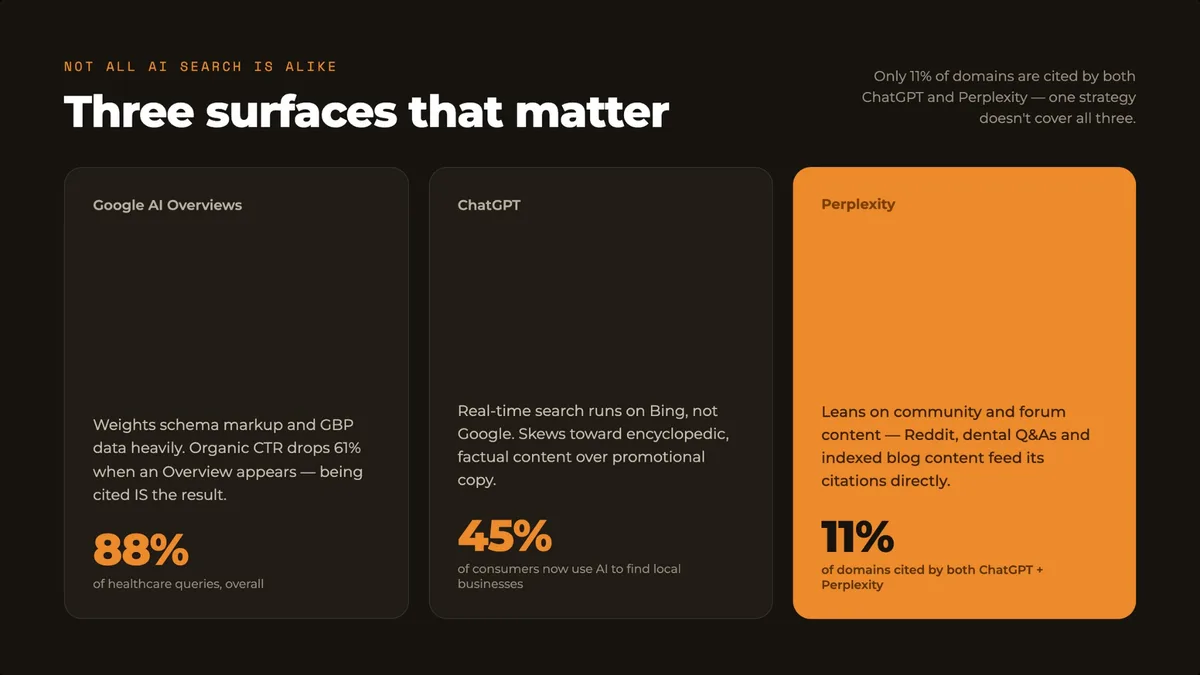
AI Overviews appear directly in Google Search results. They currently trigger on 88% of healthcare queries overall and on 100% of treatment and procedure queries specifically. According to Seer Interactive research, organic click-through rates drop 61% when an AI Overview appears on the page, which means for informational dental queries, the Overview is effectively the result.
Gemini
Gemini pulls from Google's broader index and weights Google Business Profile data more heavily than other AI platforms. IDC research from early 2026 found that schema-rich websites get priority placement in AI Overview results. For dental practices, this means your Google Business Profile optimisation and your on-page schema aren't just local SEO tasks, they directly feed Gemini's answer layer.
ChatGPT
ChatGPT's real-time web search runs on Bing, not Google. Its citation pool differs from what ranks on Google, which matters because a 2026 analysis found that only 11% of domains are cited by both ChatGPT and Perplexity. ChatGPT skews toward encyclopedic authority: well-structured, factual, comprehensive content that genuinely answers the question rather than promotional copy. According to BrightLocal's 2026 Local Consumer Review Survey, 45% of consumers used AI tools to find local businesses in the past year, up from just 6% a year earlier.
Perplexity
Perplexity places significant weight on sources it can cite and verify. It also leans more heavily on community and forum content than the other two. Patient questions answered on authoritative third-party platforms, dental association Q&As, health information sites and indexed practice blog content can drive Perplexity citations even for a practice with no deliberate Perplexity strategy.
Why most dental practices aren't showing up
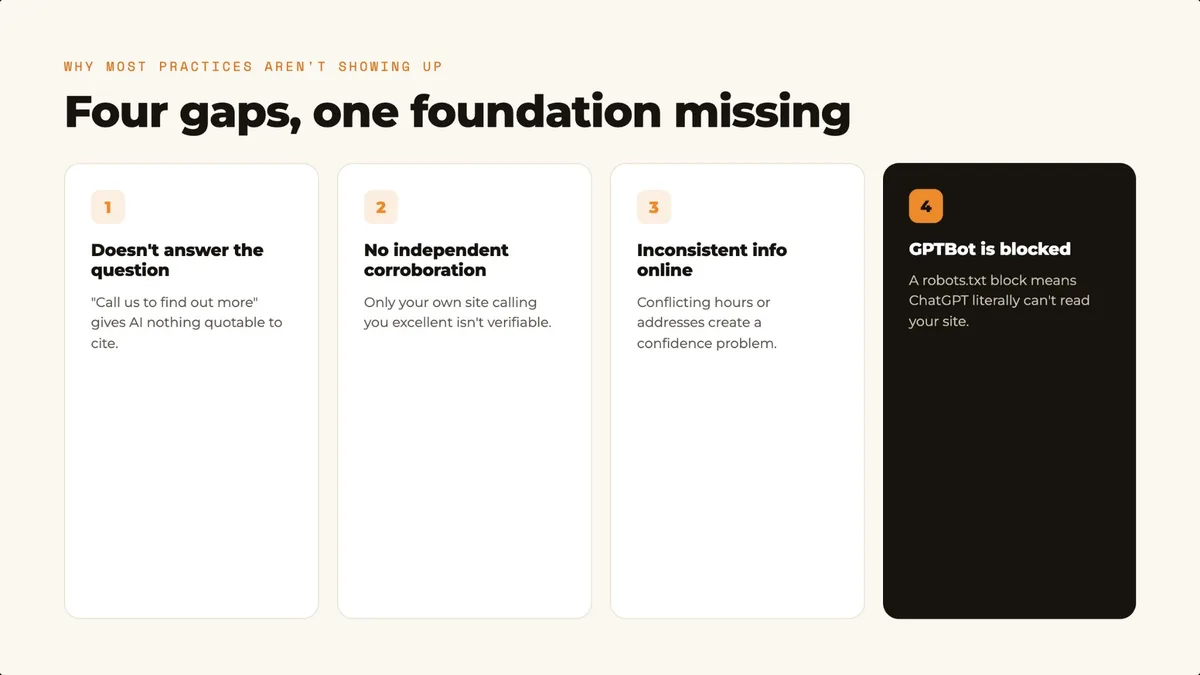
Content that doesn't actually answer the question
AI systems cite content that directly and fully answers what was asked. A treatment page that says we offer dental implants, call us to find out more gives an AI nothing to work with. A page that explains what an implant is, how long the procedure takes, what recovery involves, what it costs in a realistic range and who isn't a suitable candidate gives an AI a quotable, trustworthy source.
No independent corroboration
If the only place that calls your practice an excellent provider is your own website, that's hard for any AI to justify recommending. Third-party mentions on dental directories, local news coverage, dental association listings and genuine review platforms are how AI systems verify that a practice's claims about itself are credible.
Inconsistent or incomplete information across the web
AI platforms cross-reference your practice details across multiple sources before recommending you. Inconsistent addresses, outdated phone numbers, conflicting opening hours, or a profile that says one thing while your website says another creates a confidence problem, so the AI moves on to a practice whose information is consistent everywhere.
GPTBot is blocked
ChatGPT crawls the web using a bot called GPTBot. If your website's robots.txt file is blocking GPTBot, which is more common than it sounds on older dental websites, ChatGPT literally cannot access your pages and cannot recommend your practice based on your website content. This is a simple technical fix that most practices haven't checked.
What to actually do: six actions in priority order
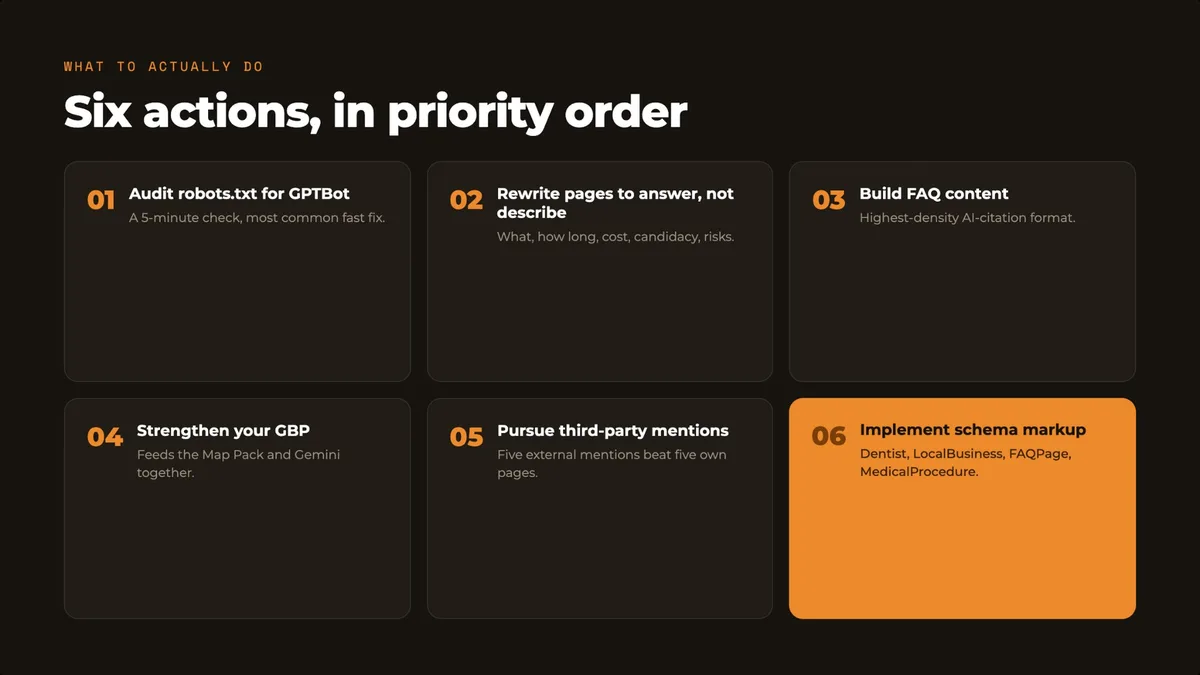
- Audit your robots.txt file for GPTBot. This is a five-minute check at yoursite.com/robots.txt and the most common, fastest-to-fix reason a dental practice doesn't appear in ChatGPT recommendations.
- Rewrite your treatment pages to answer, not just describe. Every major treatment page should answer what it is, how it works, how long it takes, what it costs in a realistic range, who is a good candidate and what the risks are.
- Build and optimise your FAQ content. FAQs are the highest-density AI-citation format available to a dental practice.
- Strengthen your Google Business Profile. A complete, accurate, actively managed profile feeds both the Map Pack and the Gemini answer layer from the same source.
- Pursue genuine third-party mentions. Being mentioned on five credible external sites carries more AI-citation weight than five additional pages on your own website.
- Implement schema markup correctly. For dental practices this means Dentist, LocalBusiness and FAQPage schema at a minimum, with MedicalProcedure schema on treatment pages.
The one check to do today
Before doing anything else, open ChatGPT or Perplexity and type: who is a good dentist for Invisalign in [your city]? Then do the same for your most important treatment. If your practice name doesn't appear, you now know what you're optimising toward. If a competitor appears, look at how their treatment pages are written compared to yours.
If you want a second pair of eyes on this, our AI search visibility service maps exactly where a practice stands across every AI surface.
Frequently asked questions
What is the difference between Google AI Overviews and ChatGPT for dental practices?
Google AI Overviews appear directly inside Google Search results and pull from Google's index, weighting schema markup and Google Business Profile data heavily. ChatGPT runs its real-time web search through Bing and skews toward encyclopedic, authority-building content. Only 11% of domains are cited by both, so optimising for one doesn't automatically cover the other.
Do dentist near me searches trigger AI Overviews?
No. According to BrightEdge research tracking healthcare queries through December 2025, Google removed AI Overviews from local provider-intent searches like dentist near me, which show 0% AI Overview coverage. The Map Pack handles these queries and remains the primary local discovery channel.
How does ChatGPT decide which dental practices to recommend?
ChatGPT looks for practices with consistent, verifiable information across multiple sources, authoritative and genuinely useful treatment content, active and accessible websites that don't block GPTBot, genuine third-party mentions and reviews, and well-structured pages that directly answer what was asked.
Does Gemini use Google Business Profile data?
Yes, more than any other AI platform. A complete, accurate and actively managed profile feeds both the Map Pack ranking and the Gemini answer layer simultaneously.
How quickly can a dental practice appear in AI search results?
A robots.txt fix can take effect within days. Content improvements can be crawled and cited within weeks. Building genuine third-party mentions and authority takes months, consistent with how long it takes to build traditional SEO authority.
Is AI search optimisation different from regular SEO for dentists?
Largely the same foundation, different emphasis. The main additions are ensuring AI crawlers aren't blocked, writing content that answers questions directly rather than describing services, and building third-party mentions beyond just backlinks.
Want results like these for your clinic?
Book a free audit and we'll show you exactly where the opportunities are.